On September 8, 1966, CBS premiered a new television show that would be a cultural phenomenon, though it only lasted three seasons originally. Star Trek was born.
Star Trek influenced me and is what led me to study physics and astronomy originally. I actually like it more than Star Wars (though I do love Star Wars) because Star Trek, to me, is more based in actual science. Many things that were shown on the show lead to physicists, engineers, and inventors creating items today because they were influenced by Star Trek.
Happy 50th Anniversary, Star Trek!
17 May 2023

20 July 2020
Comet Neowise
Right now, it is located near Ursa Major in the sky. If you live in the northern hemisphere, you can see it about half an hour after sunset, or early in the morning, when Ursa Major (the Big Dipper) is in the sky. It will be located below the bowl of the Big Dipper.
24 March 2017
Retrograde Motion
Everyone knows that over the course of a day or night, objects in the sky generally move east to west because of the Earth's rotation. But when you look at the position of the Moon and outer planets compared to the background stars, they actually move west to east. This is the apparent motion of the Moon and planets.
For example, if Mars and a star are next to each other in the sky, the next night, Mars will have moved farther east compared to the star. We call this motion prograde or direct motion.
However, there are times when the planets will have move west with respect to the background stars. This is called retrograde motion.
It is because of this retrograde motion that Ptolemy introduced the concept of epicycle to his geocentric model of the solar system. There would be not other way for retrograde motion to be explained if the planets orbited around the Earth. It wasn't until Copernicus and later Kepler that retrograde motion could be easily explained without the use of epicycles.
A good way to imagine retrograde motion is two cars on a highway. In general, a car in the fast lane will be going faster than a car in the slow lane. As the car in the fast lane approaches the slower car, both cars are going in the same direction. But as the faster car passes the slower car, to occupants in the faster car, the slower car seems to moving backwards with respect to the background trees, mountains, signs, etc.
In planetary motion, the planets closer to the Sun move faster than the planets farther away. So as Earth approaches the position of Mars, we see Mars moving west to east with respect to the background stars. However, as we get "close" to Mars, its motion seems to change direction and we have retrograde motion.
The apparent motions of Venus and Mercury are a little more complicated than that of the outer planets because they are closer to the Sun than Earth is. I'll discuss this in the next post.
For example, if Mars and a star are next to each other in the sky, the next night, Mars will have moved farther east compared to the star. We call this motion prograde or direct motion.
However, there are times when the planets will have move west with respect to the background stars. This is called retrograde motion.
It is because of this retrograde motion that Ptolemy introduced the concept of epicycle to his geocentric model of the solar system. There would be not other way for retrograde motion to be explained if the planets orbited around the Earth. It wasn't until Copernicus and later Kepler that retrograde motion could be easily explained without the use of epicycles.
A good way to imagine retrograde motion is two cars on a highway. In general, a car in the fast lane will be going faster than a car in the slow lane. As the car in the fast lane approaches the slower car, both cars are going in the same direction. But as the faster car passes the slower car, to occupants in the faster car, the slower car seems to moving backwards with respect to the background trees, mountains, signs, etc.
In planetary motion, the planets closer to the Sun move faster than the planets farther away. So as Earth approaches the position of Mars, we see Mars moving west to east with respect to the background stars. However, as we get "close" to Mars, its motion seems to change direction and we have retrograde motion.
 |
| Drawing of how retrograde motion works. Credit: Wikipedia User Rursus |
The apparent motions of Venus and Mercury are a little more complicated than that of the outer planets because they are closer to the Sun than Earth is. I'll discuss this in the next post.
26 February 2017
Annular Solar Eclipse on February 26, 2017
Today, if you are lucky enough to live in the southern hemisphere, there will be an annular solar eclipse. It is going on right now.
https://www.timeanddate.com/eclipse/solar/2017-february-26
25 February 2017
Planetary System around TRAPPIST-1
On February 22, 2017, scientists announced that there were at least seven terrestrial planets orbiting around TRAPPIST-1. Three of them are within the habitable zone. What does this mean for us?
We should learn a little about TRAPPIST-1. It is an M8V star in the constellation Aquarius, approximately 39.5 light-years (12.1 parsecs) from Earth. As an M8V star, it is smaller and cooler than Earth. In 2015, the first three Earth-sized exoplanets were discovered around the star. It wasn't until the recent announcement that they confirmed three of the planets were in the habitable zone. The habitable zone is the zone around a star where liquid water can be found. Look at the post about Earth-like planets to see why both are important.
For a star like TRAPPIST-1, the habitable zone is much closer to the star than it would be for Earth. It is likely that life might be on these planets? No, because these planets are so close to the parent star, and TRAPPIST-1 is very active, if these planets had any atmospheres at one time, they have likely been stripped away. If any life exists, it will be primitive in nature, one-celled lifeforms, if any.

We should learn a little about TRAPPIST-1. It is an M8V star in the constellation Aquarius, approximately 39.5 light-years (12.1 parsecs) from Earth. As an M8V star, it is smaller and cooler than Earth. In 2015, the first three Earth-sized exoplanets were discovered around the star. It wasn't until the recent announcement that they confirmed three of the planets were in the habitable zone. The habitable zone is the zone around a star where liquid water can be found. Look at the post about Earth-like planets to see why both are important.
For a star like TRAPPIST-1, the habitable zone is much closer to the star than it would be for Earth. It is likely that life might be on these planets? No, because these planets are so close to the parent star, and TRAPPIST-1 is very active, if these planets had any atmospheres at one time, they have likely been stripped away. If any life exists, it will be primitive in nature, one-celled lifeforms, if any.

Image courtesy of NASA
As shown in the above image, these are all considered terrestrial planets. They have radii and densities comparable to Earth. They are made up of mostly refractory elements.
31 December 2016
New Year's Eve Comet
If you have access to a telescope or binoculars and you have a clear sky, you may be able to view Comet 45P/Honda-Mrkos-Pajdušáková near the Moon.
See link below.
Comet 45P/Honda-Mrkos-Pajdušáková
See link below.
Comet 45P/Honda-Mrkos-Pajdušáková
06 September 2016
Proxima Centauri B
It has been recently announced that astronomers have discovered a possible terrestrial planet in the habitable zone around the star nearest to the Sun, Proxima Centauri. We discussed a little about Proxima Centarui when we discussed the nearest star system to the Sun, Alpha Centauri.
So what exactly does this mean? Terrestrial planets are those planets much like Earth in terms of size and composition. The habitable zone are the parts of a planetary system where water can be in liquid form on the surface of the planet. Remember, that water is a important to life in the universe.
Now, having a Earth-like planet in the habitable zone does not necessarily mean that the planet has water. We won't know for a long time, either.
So what exactly does this mean? Terrestrial planets are those planets much like Earth in terms of size and composition. The habitable zone are the parts of a planetary system where water can be in liquid form on the surface of the planet. Remember, that water is a important to life in the universe.
Now, having a Earth-like planet in the habitable zone does not necessarily mean that the planet has water. We won't know for a long time, either.
10 July 2016
July
July is the 7th month in both the Julian and Gregorian calendar. It has 31 days, and is one of the hotter months of the year in the northern hemisphere. We are going to discuss a little about the naming of the month.
In the Roman calendar, there used to be only 10 months, and July was the fifth month. It was original named Quintilis, which is Latin for fifth. When the Roman calendar changed to a 12-month calendar, it retained the name Quintilis. We will see more of this later on when we talk about the final four months of the year.
In 45 BCE, when the Julian calendar was introduced, then Roman dictator Julius Caesar had the calendar created to follow more along the lines of the actual orbit of the Sun. When he was assassinated the following year, they renamed Quintilis Julius after Caesar, and it was anglicized to July.
In the Roman calendar, there used to be only 10 months, and July was the fifth month. It was original named Quintilis, which is Latin for fifth. When the Roman calendar changed to a 12-month calendar, it retained the name Quintilis. We will see more of this later on when we talk about the final four months of the year.
In 45 BCE, when the Julian calendar was introduced, then Roman dictator Julius Caesar had the calendar created to follow more along the lines of the actual orbit of the Sun. When he was assassinated the following year, they renamed Quintilis Julius after Caesar, and it was anglicized to July.
30 June 2016
Leap Second
Everyone knows the leap day. Every four years (except century years not divisible by 100), an extra day is added to the year in February to keep the calendar in synch with the seasons.
However, there is also a leap second. This is used every couple of years to keep the Coordinated Universal Time close to the mean solar time. The reason why it is needed is that the Earth's rotation is slowing down, but not by a lot.
The second is added just before midnight on either June 30th or December 31st. The time would go from 23:59:59 to 23:59:60 to 00:00:00. The last time a leap second was added to the UTC was last June 30th.
However, there is also a leap second. This is used every couple of years to keep the Coordinated Universal Time close to the mean solar time. The reason why it is needed is that the Earth's rotation is slowing down, but not by a lot.
The second is added just before midnight on either June 30th or December 31st. The time would go from 23:59:59 to 23:59:60 to 00:00:00. The last time a leap second was added to the UTC was last June 30th.
28 June 2016
Negative Energy
Energy is what is called a scalar in physics. A scalar is a measurement that has a magnitude, but not a direction. Distance and time are other examples of a scalar. Vectors are measurements that have both magnitude and direction. Acceleration, force, and velocity are all examples of vectors.
Note: velocity and speed are not interchangeable in physics. Speed is a scalar, velocity is a vector.
Why is this important to know that energy is a scalar? Scalars are generally always zero or positive. So typically, the energy of a system is always zero or greater. The concept behind negative energy is this:
Suppose you have two objects separated by an infinite distance. The sum total of their energies is zero. Gravitational force then accelerates the two objects together. Therefore, the energy the system is increasing. But a closed system cannot change its energy. Therefore, the difference between the initial condition and the final condition is negative, hence negative energy.
Negative energy is a strange concept to understand and it's only theoretical since the above situation is very simplistic. However, if it does exist and we can harness it, negative energy can lead to humanity colonizing the galaxy (well, at least the local neighborhood). Negative energy can impact warp drives and may be used to stabilize wormholes.
Note: velocity and speed are not interchangeable in physics. Speed is a scalar, velocity is a vector.
Why is this important to know that energy is a scalar? Scalars are generally always zero or positive. So typically, the energy of a system is always zero or greater. The concept behind negative energy is this:
Suppose you have two objects separated by an infinite distance. The sum total of their energies is zero. Gravitational force then accelerates the two objects together. Therefore, the energy the system is increasing. But a closed system cannot change its energy. Therefore, the difference between the initial condition and the final condition is negative, hence negative energy.
Negative energy is a strange concept to understand and it's only theoretical since the above situation is very simplistic. However, if it does exist and we can harness it, negative energy can lead to humanity colonizing the galaxy (well, at least the local neighborhood). Negative energy can impact warp drives and may be used to stabilize wormholes.
27 June 2016
June
June is the sixth month in the Julian and Gregorian calendars. It is believed to be named after Juno, the wife of Jupiter or from the Latin iuniores meaning younger ones.
June is important astronomically as it contains the summer solstice for the Northern Hemisphere and the winter solstice for the Southern Hemisphere.
Important June events:
John Couch Adams, co-discoverer of Neptune, was born on June 5, 1819.
Johannes Muller, inventor of astronomical tables, was born on June 6, 1436.
Pope Gregory XIII was born on June 7, 1502.
Giovanni Cassini was born on June 8, 1625.
Johann G Galle, co-discoverer of Neptune, was born on June 9, 1812.
June is important astronomically as it contains the summer solstice for the Northern Hemisphere and the winter solstice for the Southern Hemisphere.
Important June events:
John Couch Adams, co-discoverer of Neptune, was born on June 5, 1819.
Johannes Muller, inventor of astronomical tables, was born on June 6, 1436.
Pope Gregory XIII was born on June 7, 1502.
Giovanni Cassini was born on June 8, 1625.
Johann G Galle, co-discoverer of Neptune, was born on June 9, 1812.
20 June 2016
Summer Solstice
June 20th, 2016 marks the official beginning of summer in the northern hemisphere. We call this day the summer solstice.
In astronomical terms, the summer solstice for the northern hemisphere occurs when the sun is the farthest north of the equator on the ecliptic. This angular distance is 23.5°, This angle also marks a line of latitude on the Earth called the Tropic of Cancer.
The Tropic of Cancer is so called because the summer solstice used to occur when the Sun was in the constellation Cancer and the latitude lines in the tropical zone. There is also a comparable line of latitude south of the equator called the Antarctic Circle. The latitude is 66.5° South and for anyone living south of this latitude (really, mostly penguins or anyone stationed in Antarctica), the Sun will never rise. Conversely, the Arctic Circle at 66.5° North, the Sun never sets. In fact, from the vernal equinox to the autumnal equinox, the North Pole is in perpetual sunlight, while the South Pole is in perpetual darkness.
The summer solstice marks the day of the year when the northern hemisphere receives the most light. From here on until the winter solstice, the days will only get shorter and the nights longer. In the southern hemisphere, the opposite occurs. Today marks the shortest day of the year and they are in winter time.
In astronomical terms, the summer solstice for the northern hemisphere occurs when the sun is the farthest north of the equator on the ecliptic. This angular distance is 23.5°, This angle also marks a line of latitude on the Earth called the Tropic of Cancer.
The Tropic of Cancer is so called because the summer solstice used to occur when the Sun was in the constellation Cancer and the latitude lines in the tropical zone. There is also a comparable line of latitude south of the equator called the Antarctic Circle. The latitude is 66.5° South and for anyone living south of this latitude (really, mostly penguins or anyone stationed in Antarctica), the Sun will never rise. Conversely, the Arctic Circle at 66.5° North, the Sun never sets. In fact, from the vernal equinox to the autumnal equinox, the North Pole is in perpetual sunlight, while the South Pole is in perpetual darkness.
The summer solstice marks the day of the year when the northern hemisphere receives the most light. From here on until the winter solstice, the days will only get shorter and the nights longer. In the southern hemisphere, the opposite occurs. Today marks the shortest day of the year and they are in winter time.
21 May 2016
Mars at Opposition
Mars will be at opposition on May 22nd, 2016.
From a previous post, we know that opposition occurs when the planet and the Sun are 180° away from each other in the sky. What this means is that when the Sun is setting, the planet will be rising. In the next couple of days, if you look to the east at sunset, Mars will be rising above the horizon. A great time to view Mars would be at midnight when it is near the apex of its path across the sky. Mars will be in Scorpius (the constellation opposite the Sun's location in Taurus) as seen here.
Because Mars is at opposition, it is the closest to us, but is still about 0.4 AU (60 million kilometers or 37.2 million miles) away from us.

From a previous post, we know that opposition occurs when the planet and the Sun are 180° away from each other in the sky. What this means is that when the Sun is setting, the planet will be rising. In the next couple of days, if you look to the east at sunset, Mars will be rising above the horizon. A great time to view Mars would be at midnight when it is near the apex of its path across the sky. Mars will be in Scorpius (the constellation opposite the Sun's location in Taurus) as seen here.
Because Mars is at opposition, it is the closest to us, but is still about 0.4 AU (60 million kilometers or 37.2 million miles) away from us.

03 May 2016
TRAPPIST-1 Planets
TRAPPIST-1 is an M8 dwarf star which is one of the coldest stars on the Hertzsprung-Russell Diagram. It has a surface temperature of about 2550 K (the Sun, by comparison has a surface temperature of 5800 K) and a mass of approximately 0.08 Solar masses.
Recently, astronomers led by Michael Gillon of the University of Liege announced that they discovered three planets orbiting TRAPPIST-1 using the transit method. The two closest are tidally locked to their parent star, much like the Moon is tidally locked to Earth. However, the third planet lies just at the outer edge or beyond the habitable zone of the star.
Theoretically, this planet could harbor life, but in all likelihood, it would nothing like Earth life. By being in the habitable zone, this means that water would be in liquid form, which astronomers believe would be necessary for life to exist.
Recently, astronomers led by Michael Gillon of the University of Liege announced that they discovered three planets orbiting TRAPPIST-1 using the transit method. The two closest are tidally locked to their parent star, much like the Moon is tidally locked to Earth. However, the third planet lies just at the outer edge or beyond the habitable zone of the star.
Theoretically, this planet could harbor life, but in all likelihood, it would nothing like Earth life. By being in the habitable zone, this means that water would be in liquid form, which astronomers believe would be necessary for life to exist.
02 May 2016
Transit of Mercury
On May 9, 2016, the planet Mercury will transit across the face of the Sun and for most of the Earth, the transit will be visible (or at least portions of it).
The transit begins at 11:12 UTC (Coordinated Universal Time measured at Greenwich, England) and ends at 18:42 UTC. To determine your time offset from UTC, Wikipedia has a good summary. For example, in Pittsburgh (where I live), we are currently only four hours behind UTC due to daylight savings time. So in Pittsburgh, the transit begins at 7:12 AM and ends at 2:42 PM.
To see the transit, you should not look directly at the Sun.. There are a couple of ways to look at it, however.
The transit begins at 11:12 UTC (Coordinated Universal Time measured at Greenwich, England) and ends at 18:42 UTC. To determine your time offset from UTC, Wikipedia has a good summary. For example, in Pittsburgh (where I live), we are currently only four hours behind UTC due to daylight savings time. So in Pittsburgh, the transit begins at 7:12 AM and ends at 2:42 PM.
To see the transit, you should not look directly at the Sun.. There are a couple of ways to look at it, however.
- Have a Sun filter for a telescope, binoculars, or camera.
- Watch it online at NASA.gov.
30 April 2016
Molecular Clouds
Molecular clouds are regions of gas and dust from which stars and planets form. They are generally colder regions, so are darker than the surrounding areas. They can only be seen when they are in front of a brighter region and appear as "holes" in space.
A good example of a molecular cloud is the Horsehead Nebula in Orion.

A good example of a molecular cloud is the Horsehead Nebula in Orion.

Credit and Copyright: Jean-Charles Cuillandre (CFHT), Hawaiian Starlight, CFHT
These clouds are also called dark nebula because they don't emit radiation in the visible spectrum. These are the regions of space where stars and planets form. The cloud will start to collapse because of an outside force, like the wavefront of a supernova. The collapse will also create rotation on the cloud. From the conservation of angular momentum, as the cloud collapses, the rotation also speeds up. At the core of the cloud, the density increases and the temperature increases. This is where the protostar is formed. The outer sections of the cloud are where planets, dwarf planets, asteroids, comets, and other bodies in a planetary system will form.
27 April 2016
The Satellite of Makemake
Makemake is a dwarf planet in the outer edges of the solar system in the Kuiper Belt. It was discovered in March 2005, and announced by Mike Brown in July of 2005. It is about 2/3 the size of Pluto, so it is relatively small. However, it was recently discovered that Makemake has a companion body discovered in April of 2016 (from images taken in April of 2015 from the Hubble Space Telescope). It is not the only dwarf planet with a satellite.
Pluto has five, including Charon. Eris, the largest dwarf planet by mass (Pluto is larger by volume), has one (Dysnomia). Haumea has two. Satellites around dwarf planets may be pretty common.
Pluto has five, including Charon. Eris, the largest dwarf planet by mass (Pluto is larger by volume), has one (Dysnomia). Haumea has two. Satellites around dwarf planets may be pretty common.
22 April 2016
April
April is the fourth month of both the Julian and Gregorian calendar. It was once the second month of the old Roman calendar until the Numa calendar was created in 700s BCE. Where does the name April come from?
There are many ideas. One is that is named for the Roman word aperire which means to open, as this it the first full month of spring and flowers begin to open. It could also be related the Greek goddess Aphrodite whose Roman equivalent Venus held the month sacred.
The zodiac constellations (according the pseudo-science astrology) are Aries (the ram) and Taurus (the bull). In actuality, the Sun is in the constellation Aries right now, but was in Pisces (the fish) up until April 19. The Sun won't be in Taurus until mid May. The original astrological signs were based on the Sun's position 2000 years ago and was covered on my post about the precession of the equinoxes. You can also revisit my post about the Zodiac, as well.
Next month, we'll talk about May...and a lot sooner than near the end of the month.
There are many ideas. One is that is named for the Roman word aperire which means to open, as this it the first full month of spring and flowers begin to open. It could also be related the Greek goddess Aphrodite whose Roman equivalent Venus held the month sacred.
The zodiac constellations (according the pseudo-science astrology) are Aries (the ram) and Taurus (the bull). In actuality, the Sun is in the constellation Aries right now, but was in Pisces (the fish) up until April 19. The Sun won't be in Taurus until mid May. The original astrological signs were based on the Sun's position 2000 years ago and was covered on my post about the precession of the equinoxes. You can also revisit my post about the Zodiac, as well.
Next month, we'll talk about May...and a lot sooner than near the end of the month.
17 March 2016
March
March is the third month of the Gregorian calendar. It is named after the Roman god Mars.
Did you know, in the old Roman calendar, it was actually the first month? The original Roman calendar contained ten months, from March through December. It wasn't until Julius Caesar introduced his namesake calendar in 46 BC.
Some interesting notes to know about March: it is the birth month of Albert Einstein (born March 14, 1879), it has the fun mathematical day called Pi (π) Day which is also 3-14, and it has the vernal equinox, which we will talk about later.
Did you know, in the old Roman calendar, it was actually the first month? The original Roman calendar contained ten months, from March through December. It wasn't until Julius Caesar introduced his namesake calendar in 46 BC.
Some interesting notes to know about March: it is the birth month of Albert Einstein (born March 14, 1879), it has the fun mathematical day called Pi (π) Day which is also 3-14, and it has the vernal equinox, which we will talk about later.
08 March 2016
Total Solar Eclipse for March 8-9, 2016
There will be a total solar eclipse today, but only if you are in the areas below. Australians and Southeast Asians will have the best view. Some in Hawai'i will see a partial solar eclipse.
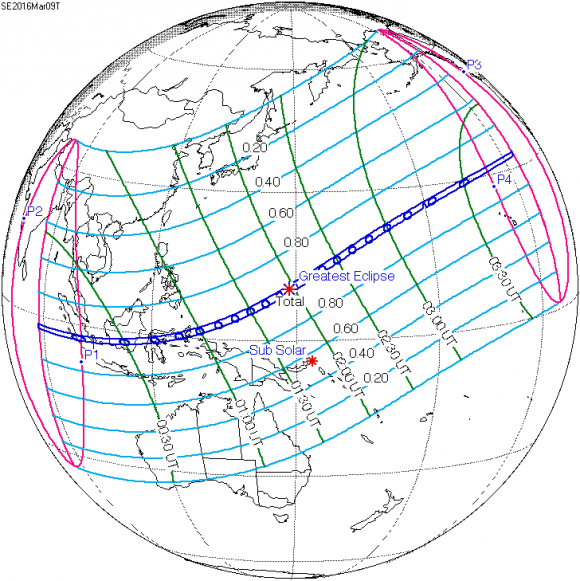
See this link for more information.
Subscribe to:
Posts (Atom)