Showing posts with label new moon. Show all posts

26 February 2017

Annular Solar Eclipse on February 26, 2017

Today, if you are lucky enough to live in the southern hemisphere, there will be an annular solar eclipse. It is going on right now.

https://www.timeanddate.com/eclipse/solar/2017-february-26

08 March 2016

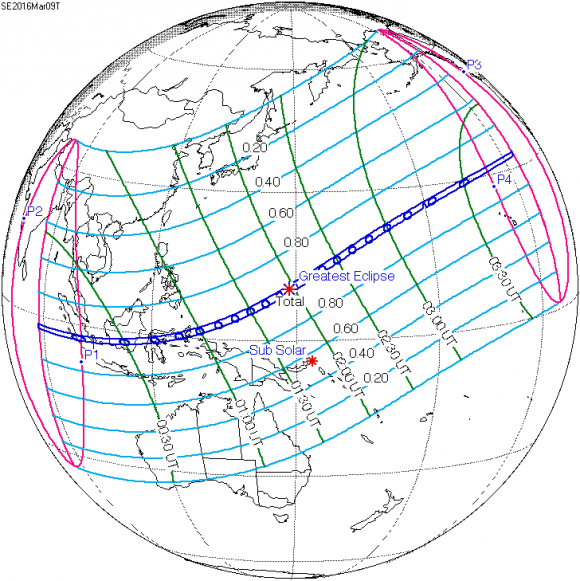
Total Solar Eclipse for March 8-9, 2016

There will be a total solar eclipse today, but only if you are in the areas below. Australians and Southeast Asians will have the best view. Some in Hawai'i will see a partial solar eclipse.


See this link for more information.

16 March 2015

Solar Eclipse of 20 March 2015

There is a solar eclipse this week that will be visible in a small portion of the world. So for my readers in Europe and northwest Asia, you will get to see a partial eclipse. If you live in the archipelago of Svalbard, you will be able to see the total eclipse.

All information below is from Time and Date.com
Area seeing the total solar eclipse.
More than 90% of the sun is covered.
Up to 90% of the sun is covered.
Up to 40% of the sun is covered.
Eclipse is not visible at all.
Note: Percentage values (%) relate to moon coverage of the sun and depends on location. Visibility is weather permitting.

Here are the times the eclipse will be visible.
EventUTC Time
First location to see partial eclipse beginMar 20 at 7:41 AM
First location to see full Eclipse beginMar 20 at 9:09 AM
Maximum EclipseMar 20 at 9:45 AM
Last location to see full Eclipse endMar 20 at 10:22 AM
Last location to see partial Eclipse endMar 20 at 11:50 AM

18 October 2014

Solar Eclipse of 23 October 2014

On October 23, 2014, there will be a partial solar eclipse visible to most of North America and extreme eastern Siberia.
 
EventUTC Time
First location to see partial eclipse beginOct 23 at 7:38 PM
Maximum EclipseOct 23 at 9:45 PM
Last location to see partial Eclipse endOct 23 at 11:52 PM
 
 
Adjust time accordingly for your time zone.
  • Eastern Daylight Time = -4 hours
  • Central Daylight Time = -5 hours
  • Mountain Daylight Time = -6 hours
  • Pacific Daylight Time = - 7 hours
Here is a nice map from NASA.

26 July 2014

Eclipses

Previously, we learned about the phases of the Moon. We saw how it goes from new Moon to full Moon back to new Moon again. We know that during the new phase, the Moon is between us and the Sun. During the full phase, the Earth is between the Sun and the Moon. We also know the apparent diameter of the Sun and the Moon are nearly identical, at about 0.5°.  So how come we don't see the Moon blocked out when its full and why isn't the Sun always eclipsed during the new Moon phase?

The main reason why is the Earth and the Moon do not orbit in the same plane.  The Moon's inclination is about 5° compared to the ecliptic.  Therefore, during most new Moon phases or most full Moon phases, the Moon is not in the same alignment with the Earth and the Sun.  This 5° inclination leads to the eclipses to happen every six months.


There are two types of eclipses: solar eclipses and lunar eclipses.  Solar eclipses occur when the Moon crosses in front of the Sun, blocking us from seeing the Sun on Earth.  Lunar eclipses occur when the Moon passes through the shadow of the Earth.  A lunar eclipse (or a solar eclipse) follows two weeks after the associated solar (or lunar) eclipse.  Solar eclipses and lunar eclipses never occur more than 14 days apart.

Lunar eclipses occur during the full Moon phase as the Earth is between the Moon and the Sun.  If the Moon is completely in the shadow, or umbra, of the Earth.  Since the Earth is so much larger than the Moon, the shadow of the Earth completely envelopes the Moon during a lunar eclipse.  Also, this allows a lunar eclipse to occur even if the Earth, Sun and Moon are not completely in line.  If the Moon is slightly out of the umbra and partially in the penumbra, partial lunar eclipses will occur.  From viewing partial lunar eclipses, ancient astronomers could tell that the Earth was round, not flat, because of the shape of the Earth's shadow on the Moon.


Solar eclipses occur during the new Moon phase when the Moon crosses in front of the Sun.  These are only total if the Moon is near perigee and the Sun, Moon, and Earth are completely aligned.  If the Moon is nearer apogee than perigee, a solar eclipse will be annular, or ring-like, because there will be a ring of sunlight around the outline of the Moon.  As with lunar eclipses, if the Moon is slightly off center of the ecliptic, then a partial solar eclipse will occur.
Total Solar Eclipse (NASA)

Annular Solar Eclipse (Wikipedia)
In the future, total solar eclipses will not longer occur because the Moon is moving away from the Earth at a rate of 2 cm/century.  We will learn more about the recession of the Moon later.

10 July 2014

The Phases of the Moon

We are going to take a break from talking about Venus to explain about the phases of the Moon.  This background is necessary when we get into the next post about Venus.

The Moon goes through basically eight phases as it orbits the Earth.  These phases are a result of the Moon's alignment with both the Earth and the Sun.  Before we go into the descriptions of the phases, we should define two terms:

The sidereal lunar cycle, or "sidereal month" is how long it takes the Earth, Moon, and a background star to line up.  This period last about 27.3 days.  After another 2.2 days, the Earth, Moon, and Sun are lined up in what is called the lunar month, or synodic month.  This period is approximately 29.5 days.  The difference between these periods is because as the Moon orbits the Earth, the Earth is also orbiting the Sun.

The first phase during the lunar month is called the "New Moon".  Basically, it is when the Moon is between the Earth and the Sun.  The unilluminated face of the Moon is pointed towards the Earth.  However, the new Moon is not completely dark.  Earthshine, reflection of sunlight off the Earth's surface can illuminate the surface of the Moon.
 
The next phase is the Waxing Crescent phase.  Waxing in astronomy means that something is increasing in size.  As the Moon moves around the Sun, a sliver of the Moon on the right limb is illuminated by the Sun as seen from the Earth.  What we see is the crescent shape of the Moon.


The Moon is said to be aging as it goes from New Moon to Waxing Crescent.  About a week after the New Moon, the Moon reaches the First Quarter phase because it has reached the end of one quarter of the lunar cycle.  The entire right half of the Moon is illuminated as seen from the Earth.

 
The next phase is called Waxing Gibbous.  The illuminated surface of the moon crosses the center of the moon and spills over into the left half of the Moon.  The illuminated portion of the Moon resembles an oval with pointed ends.

Halfway through the lunar cycle, we hit the Full Moon. No, werewolves do not appear during the Full Moon.  People do not get crazy during the Full Moon, though it may appear to be so.  The Full Moon is the phase where the Earth is between the Sun and the Moon and from Earth we see the entire face of the Moon illuminated.
After the full Moon passes, the illuminated portion of the Moon begins to decrease, or wane.  The next phase is the Waning Gibbous phase.  The right limb has a darkened crescent shape, and the left half and a portion of the right half of the Moon are illuminated, opposite the Waxing Crescent phase.

After three weeks in the lunar cycle, the Moon reaches the Last Quarter or sometimes called Third Quarter.  It is called this because either the Moon is at the beginning of the last week of the lunar cycle or the end of the third week of the lunar cycle.

In the final week before the Moon is "reborn" into the New Moon, the Moon goes through the Waning Crescent phase.  Only a sliver on the left limb of the Moon is illuminated. 
 
Here is an image showing the relative position of the phases with respect to the Earth and the Sun.