Showing posts with label Astronomy. Show all posts

02 October 2015

Autumnal Equinox

This past September 23rd, the northern hemisphere experienced the beginning of our fall season.

In terms of astronomy, what does this mean?

In the sky, if we could see the ecliptic, the path the Sun travels on as it appears to cross the sky, the point of the autumnal equinox occurs when the Sun crosses the celestial equator as it travels south on the ecliptic. This marks the beginning of autumn for all of us in the northern hemisphere, and the beginning of the spring for those in the southern hemisphere.

Another way to look at it, is that the Sun is directly overhead at the equator, which means that the Earth itself is tilted in the plane perpendicular to the Sun. Neither the northern hemisphere or the southern hemisphere is tilted towards the Sun. But at this point, the southern hemisphere will begin to receive more sunlight as the southern hemisphere is beginning to be tilted more towards the Sun.


03 August 2015

Bright Spots on Ceres


I have previously posted about asteroid/dwarf planet Ceres before. The Dawn Spacecraft recently arrived at Ceres and began a comprehensive study of the dwarf planet that has never been done before. One of the strange things that Dawn found on Ceres were bright spots that confounded scientists at first. What were they?


http://www.nasa.gov/sites/default/files/thumbnails/image/pia19185-cr.jpg


The bright spots were discovered in a crater now known as Occator, an 80-km diameter crater at 19.5° latitude on Ceres. They are called faculae which means “bright spots”. Faculae are more commonly known as the bright regions on the Sun surrounding a sunspot. Where do the faculae on Ceres come from?


One theory is that they are ice spots in the crater that are reflecting sunlight or salt deposits left over after salty water on the surface evaporated away. These spots might have come from Ceres actually having a dusty surface, and minor impacts on the surface exposed the underlying ice or salt.


Another theory, which is more widely accepted, is that the spots are actually ice geysers or cryovolcanoes (volcanoes that spew ice rather than lava). This is believed to be the true cause as Dawn has seen haze above the spots.


We will probably learn more as Dawn continues its reconnaissance around Ceres. And if these are ice features, Ceres could be a great place to build a future way station in the Solar System.


31 July 2015

Blue Moon

Tonight, July 31st, a rare occurrence will happen. You can say that it is something that happens once in a blue moon, because it is a blue moon.


What do we mean by a blue moon? There are actually two definitions of what a blue moon is.
  1. A blue moon is the third full moon in a season where four full moons occur. Most times, there are only three full moons in one season, but on the rare occasion when a full moon is at the beginning of the season, the season may have four.
  2. A blue moon may also mean the second full moon in a calendar month. The full moon of tonight is this type of blue moon.
Why do blue moons occur and why are they rare? If you go back to when we discussed the lunar cycle and the synodic period of the moon, we know that the time from one full moon to the successive full moon is approximately 29.5 days. Calendar months last anywhere from 28 days to 31 days. Therefore, if a full moon is on the first of a month, that month will have a blue moon (second definition). The seasons are, on average, a little over 90 days. As stated above, if the full moon occurs on the solstice or equinox (or a day after), it is possible to have four full moons in the season.


If you miss the blue moon tonight, don't worry. There will be another blue moon on May 21, 2016. This will be the third blue moon in the northern spring (southern fall) of 2016.

21 July 2015

Syzygy


In astronomy, objects can always cross in front of another object, if the alignments are right. They are usually referred to one of three terms: an eclipse, a transit, or an occultation. These three terms are part of a broader definition called a syzygy*.


   *Syzygy in astronomy is when three bodies are in a line.


Let's define the three of them.


Previously, I posted about eclipses of the Moon. These occur when the Moon, Sun, and the Earth are lined up in such a way that the Moon eclipses the Sun (a total solar eclipse), or the Moon goes through the Earth's shadow (a lunar eclipse). An eclipse can also happen in multiple star systems when one companion star passes in front of the other. What occurs is that the obscured body is either completed blocked out temporarily as it passes through the shadow of the eclipsing body (lunar eclipse) or the eclipsing body passes between the observer and the eclipsed object (total solar eclipse).


A transit is when a smaller body passes in front of a larger body, mostly a planet crossing in front of a star, but can also occur when a moon crosses in front of a planet, partially blocking out the Sun. Transits of extra-solar planets can be used to help astronomers find the planet and determine its size based on the light-curve of the star. Exoplanet transits are discussed more here. Transits occur in the inner solar system when Mercury and Venus cross in front of the Sun as seen from Earth. On my post about opposition and conjunction, what configuration(s) are Mercury and Venus in when they transit the Sun? Comment below if you know the answer. Also, the moons of Jupiter and Saturn can also transit across the face of their parent planets.


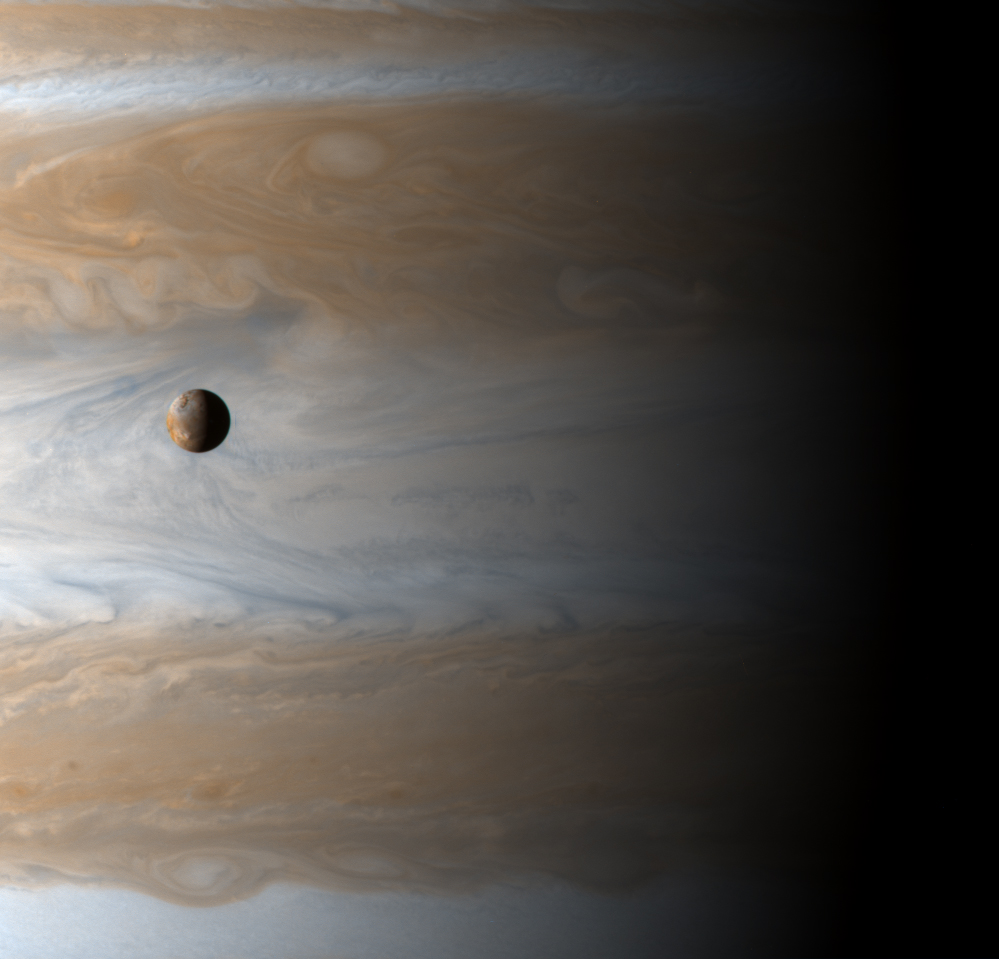
File:PIA02879 - A New Year for Jupiter and Io.jpg


Released with Image The Galilean satellite Io floats above the cloudtops of Jupiter in this image captured on the dawn of the new millennium, January 1, 2001 10:00 UTC (spacecraft time), two days after Cassini's closest approach. The image is deceiving: there are 350,000 kilometers -- roughly 2.5 Jupiters -- between Io and Jupiter's clouds. Io is the size of our Moon, and Jupiter is very big.


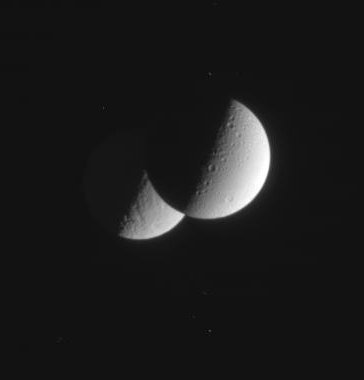
The last example of syzygy in astronomy is called occultation. In this case, the body that crosses between the observer and the more distant object appears much larger. These occur when the Moon, the Sun, or a planet pass in front of distant star, when the Moon passes in front of a planet, or when the satellite of a planet passes in front of an apparently smaller satellite.


File:Dione Rhea Occultation.jpg


Dione occulting Rhea (two moons of Saturn)


In picture form, this is what the three types of syzygy look like:


02 July 2015

Conjunction and Opposition


Sometimes, there are unique occurrences when planets align themselves with the Earth and the Sun. We actually have specific names for these occurrences: opposition and conjunction.


Opposition occurs when the Sun and the planet are in opposite directions in the sky, i.e. 180° apart in the sky. The Full Moon is also an example of opposition. Venus and Mercury, however, can never be in opposition. In my post about the morning and evening star, we know that Venus is never farther than 47.8° and Mercury is never more than 27.8° from the Sun.


Conjunctions happen to all the planets. The best way to think of it is when a planet and the Sun are in relatively the same direction in the sky. When the outer planets (Mars, Jupiter, Saturn, Uranus, and Neptune) are in the same direction as the Sun, we just refer to it as a conjunction. However, since Venus and Mercury can actually be at conjunction at two different points in their orbits, we need to specify their two conjunctions. When the inner planet is closest to the Earth, we call that its inferior conjunction because it is closer to the Earth than the Sun and when its at its furthest point, we call that the superior conjunction.


Planets can also be at conjunction with other planets. A good example is now visible in the night sky. Right now for a few days, Jupiter and Venus are near each other in the sky, and depending on your telescope or binoculars, are in the same field of view.


Venus and Jupiter in conjunction, with the full moon to give scale.


Via APOD


Composite Image Credit & Copyright: Wang, Letian


30 June 2015

Constellations and Asterisms

I've discussed constellations before but never really defined what they are. A constellation is a group of stars that are in the same approximate area in the sky. These stars generally are not associated with each other except that they are all in the same location in the sky.


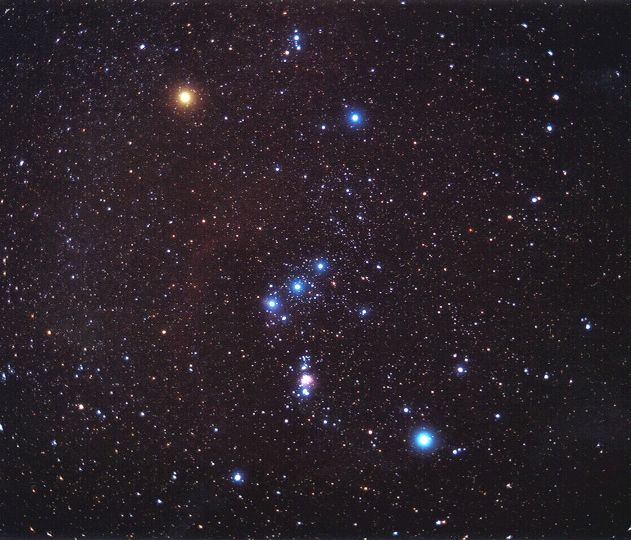
For example, Orion has two really bright stars: Rigel, a blue supergiant that is the left foot of the Hunter, and Betelgeuse, a red supergiant that is the right shoulder. In the sky, they are only separated by 18.29°, but in space Rigel is 260 pc from Earth and Betelgeuse is 197 pc from Earth. Same area of the sky, but really far apart in space.
See Explanation.  Clicking on the picture will download
 the highest resolution version available.
From APOD
Credit & Copyright: Matthew Spinelli
Betelgeuse is also part of something called an asterism: a smaller group of stars in the same general area in the sky that can either be a part of a constellation, or stars that are in other constellations. The asterism to which Betelgeuse belong is called the Winter Triangle along with Sirius (the Dog Star, the brightest star in Canis Major) and Procyon (the brightest star in Canis Minor).
Winter Triangle
Procyon, Betelgeuse and Sirius form the Winter Triangle.

Remember the zodiac is made up of thirteen constellations. In all, there are 88 recognized constellations in the nighttime sky. I am not going to list them all here, but they can easily be found by using your favorite search engine to find them listed. Constellation names are used to actually describe stars in terms of what constellation you may find them. For example, α Centauri (one of the closest stars to our Sun) is found in the constellations Centaurus, hence Centauri. Rigel is also known as β Orionis and Betelgeuse is α Orionis. (I'll explain what the Greek letters before a constellation name means - Bayer designation).

Other example of asterisms include the Big Dipper and the Little Dipper, which are smaller portions of the constellations Ursa Major (Big Bear) and Ursa Minor (Little Bear), respectively. How many other asterisms do you know of?