30 April 2016

Molecular Clouds

Molecular clouds are regions of gas and dust from which stars and planets form. They are generally colder regions, so are darker than the surrounding areas. They can only be seen when they are in front of a brighter region and appear as "holes" in space.

A good example of a molecular cloud is the Horsehead Nebula in Orion.

These clouds are also called dark nebula because they don't emit radiation in the visible spectrum. These are the regions of space where stars and planets form. The cloud will start to collapse because of an outside force, like the wavefront of a supernova. The collapse will also create rotation on the cloud. From the conservation of angular momentum, as the cloud collapses, the rotation also speeds up. At the core of the cloud, the density increases and the temperature increases. This is where the protostar is formed. The outer sections of the cloud are where planets, dwarf planets, asteroids, comets, and other bodies in a planetary system will form.

27 April 2016

The Satellite of Makemake

Makemake is a dwarf planet in the outer edges of the solar system in the Kuiper Belt. It was discovered in March 2005, and announced by Mike Brown in July of 2005. It is about 2/3 the size of Pluto, so it is relatively small. However, it was recently discovered that Makemake has a companion body discovered in April of 2016 (from images taken in April of 2015 from the Hubble Space Telescope). It is not the only dwarf planet with a satellite.

Pluto has five, including Charon. Eris, the largest dwarf planet by mass (Pluto is larger by volume), has one (Dysnomia). Haumea has two. Satellites around dwarf planets may be pretty common.

22 April 2016

April

April is the fourth month of both the Julian and Gregorian calendar. It was once the second month of the old Roman calendar until the Numa calendar was created in 700s BCE. Where does the name April come from?


There are many ideas. One is that is named for the Roman word aperire which means to open, as this it the first full month of spring and flowers begin to open. It could also be related the Greek goddess Aphrodite whose Roman equivalent Venus held the month sacred.


The zodiac constellations (according the pseudo-science astrology) are Aries (the ram) and Taurus (the bull). In actuality, the Sun is in the constellation Aries right now, but was in Pisces (the fish) up until April 19. The Sun won't be in Taurus until mid May. The original astrological signs were based on the Sun's position 2000 years ago and was covered on my post about the precession of the equinoxes. You can also revisit my post about the Zodiac, as well.


Next month, we'll talk about May...and a lot sooner than near the end of the month.

17 March 2016

March

March is the third month of the Gregorian calendar. It is named after the Roman god Mars.


Did you know, in the old Roman calendar, it was actually the first month? The original Roman calendar contained ten months, from March through December. It wasn't until Julius Caesar introduced his namesake calendar in 46 BC.


Some interesting notes to know about March: it is the birth month of Albert Einstein (born March 14, 1879), it has the fun mathematical day called Pi (π) Day which is also 3-14, and it has the vernal equinox, which we will talk about later.

08 March 2016

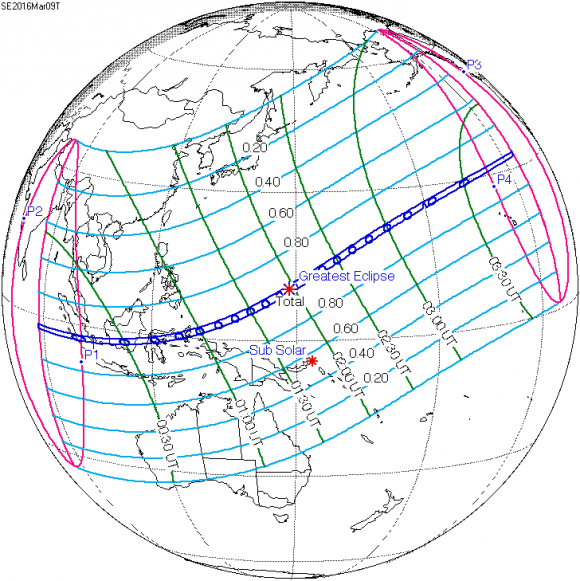
Total Solar Eclipse for March 8-9, 2016

There will be a total solar eclipse today, but only if you are in the areas below. Australians and Southeast Asians will have the best view. Some in Hawai'i will see a partial solar eclipse.


See this link for more information.

02 March 2016

Leap Day


Under Julius Caesar, the idea of a leap day/leap year was added to help keep the seasons in alignment with the calendar. Leap days were added every four years to account for the orbit of the Earth around the Sun, which was approximately 365.25 days (it is actually 365.2425 days).


This calendar worked fine until 1582, when Pope Gregory XIII wanted to make sure that the Christian holy days fell around the same time every year. By 1582, the Julian calendar was out of sync with the seasons by 10 days. The calendar developed under Gregory was able to account for the difference between 365.25 days and 365.2425 days. We still have a leap day every four years, but to help account for above difference, this calendar did not have a leap year if the years was divisible by 100 but not by 400. For example, 2000 was a leap year since it is divisible by 400. But 1900 was not and 2100 will not be leap years. This will help keep the calendar in sync with the seasons until 9282, meaning an error of only 1 day every 7700 years. The Julian calendar had an error of 1 days every 128 years.


26 February 2016

Alpha Centauri

Alpha Centauri is the closest star system to our Sun. It is actually a triple star system, with Alpha Centauri A, a G2V star much like our Sun, Alpha Centauri B, a slightly smaller and cooler K1V star, and Proxima Centauri (also Alpha Centauri C), an M6V red dwarf. Proxima Centauri is named thus, because is the closest star to our Sun.


Alpha Centauri is approximately 4.34 light years away, and as shown above, the largest of the stars is very similar to the Sun. This stellar system is important and will be the first star system humanity will ever visit when we are finally able to leave our own Solar System. Right now, it would take about 81,000 years with our fastest spacecraft technology to reach the star system.


Once we get to Alpha Centauri, we will be able to see if it has planets similar to ours and if the planetary system would be recognizable to us. We would want to see if there were any Earth-like planets and if there could be life on them. Just like the Moon should be our first logical step in colonizing the Solar System, Alpha Centauri is the first logical step in exploring our galaxy.