Showing posts with label reflection. Show all posts

10 June 2015

Reflection


The reflection of light is just the bouncing of a light wave or a photon (however you want to look at it) from a surface. The reflection of light off a flat surface is pretty simple to understand.


Light comes in at an angle and is reflected off the surface at the same angle. Using physics terms, the angle of incidence is equal to the angle of reflection and are measured from the normal to the surface. Recall that the normal to a surface is an imaginary line that is perpendicular to that surface, in this case, a perpendicular to the point of reflection.


In cases of spherical mirrors, the reflection gets a little more complicated. If you have light coming into the mirror in parallel beams or rays from the same source, the light will not be reflected to the same point. This is called spherical aberration.


But the objective mirror of a reflector is a curved mirror! And they don't suffer from spherical aberration. How does this work?


Instead of using spherical mirrors, reflectors use parabolic mirrors. A parabola is a shape that has a focal point. This way, when a mirror has a parabolic shape, parallel light beams will be reflected to the same point in front of the mirror. A reflector then will use a secondary mirror to reflect the light off to the side (Newtonian reflector) or back down the end (Cassegrain reflector).


Parabolic mirrors are not as extremely curved as the one shown above, but I've exaggerated the curvature so that it can be seen how all incident light parallel to each other (i.e. coming from the same source) will reflect off the mirror and reach a common focal point on the reflected path.


See my post on telescopes for more about the different types of telescopes.


19 May 2015

Why Is the Sky Blue?

Believe it or not, we've actually discussed this before. When we've talked about reflection nebulae, we mentioned how the blue light is reflected towards our line of sight. In the same way, the sky is blue.
Remember, that light is composed of all colors of light. When light from the Sun enters the atmosphere, the dust in the sky easily reflects the blue wavelengths because they are shorter. The longer wavelengths (red, orange, yellow) pass right by the dust particles. The blue light is dispersed over the whole sky and when we look at the sky, we see blue. Of course, when we look at the Sun (which you should never do without proper eye protection), the Sun is yellowish (more yellow light in the Sun's spectrum than orange or red.
However, at sunrise or sunset, the sky around the Sun is orangish-red. Why is this? There are two reasons:
1.      The blue light is scattering away from our line of sight so all we see from the Sun are reds and oranges.
2.      The amount of atmosphere the light travels through to reach our eyes is more at sunrise and sunset than when the Sun is directly overhead. More dust (and pollution) for the blue light to interact with and be reflected away from us.


07 January 2015

Reflection Nebula

Much like emission nebulae, reflection nebulae are full of gas and dust. However, the way they are oriented with stars means that they will look different.
NGC 1977: Blue Reflection Nebula in Orion
Credit: Anglo-Australian Telescope photograph by David Malin
Copyright: Anglo-Australian Telescope Board
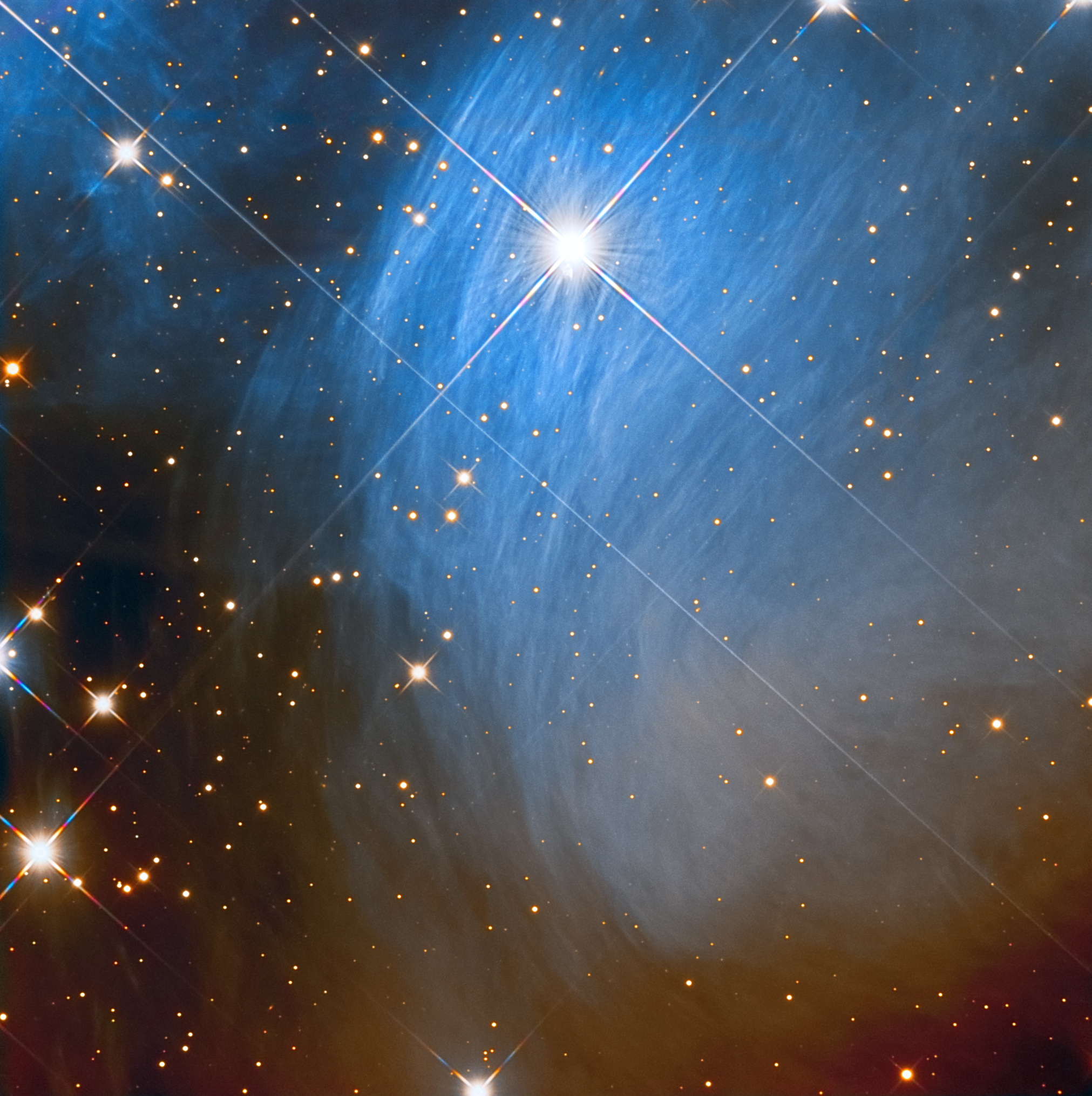
Merope's Reflection Nebula
Image Credit & Copyright: Leonardo Orazi


Reflection nebulae do just what they name implies: they reflect light. When a star is off to the side of the nebula, as seen from Earth, the nebula will reflect the bluer light (i.e. the shorter wavelengths) towards Earth, and the nebula will appear bluish in color. The reason why the bluer light is reflected and not the redder light is the wavelengths. The gas and dust particles are small enough that the blue light will interact with them and be reflected while the redder light, on average, will just pass by the dust and gas.
How do we know that that reflected light is from the star? By looking at the spectra of the star and the nebula. A reflection nebula will have the same spectrum as the star that the light came from.


While the blue light is reflected, we know the red light passes through. This leads to another interesting phenomenon: reflection nebula can actual cause a star to appear redder than it really is. This is called stellar reddening.