Showing posts with label metallicity. Show all posts

22 January 2015

Irregular Galaxies

Irregular galaxies are the final major type of galaxies. These galaxies are the smallest of the three types.


The best way to describe an irregular galaxy is to compare them to open clusters. Open clusters are groups of stars that don't have an overall structure, but are gravitationally bound to each other. Irregular galaxies are large groups of stars that have no overall structure, but are also gravitationally bound to each other.


Obviously, an irregular galaxy is much larger than an open cluster, but are usually found orbiting a larger galaxy. These satellite galaxies were formed around the same time as their parent galaxy were formed, but since they don't have as much mass, they didn't grow into a spiral galaxy or elliptical galaxy. In irregular galaxies, we do find that they have a lot of gas and dust, which means they undergo active star formation. This also means that generally these are younger galaxies, with the stars forming after the galaxy formed.


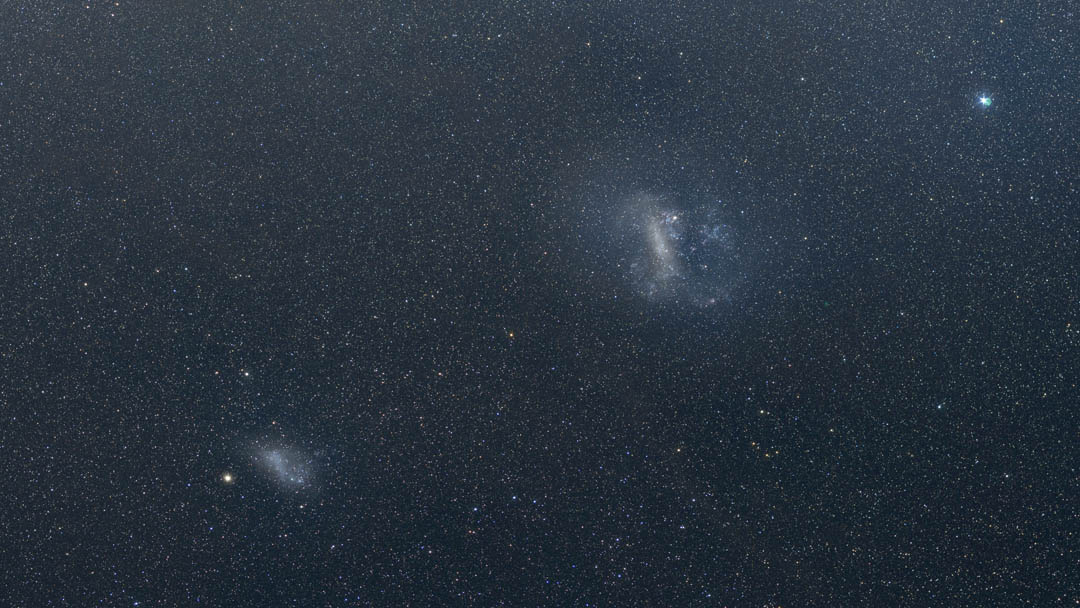
The best examples of irregular galaxies (stylized as Irr) are the Large Magellanic Cloud (LMC) and the Small Magellanic Cloud (SMC), which can both be seen in the southern night sky.
  • LMC is at -69° declination (seen only at latitudes south of 21°N)
  • SMC is at -72° declination (seen only at latitudes south of 18°N)
File:Small Magellanic Cloud (Digitized Sky Survey 2).jpg


21 January 2015

Spiral Galaxies

Spiral galaxies are just want they sound like. They look like whirlpools, pinwheels, anything that has arms rotating around a central body. In fact, there are two galaxies named the Whirlpool Galaxy and Pinwheel Galaxy, and surprise, surprise, they are spiral galaxies.
Whirlpool Galaxy
Image Credit:

Pinwheel Galaxy
Pinwheel Galaxy
Image Credit:
  NASA, ESA, CFHT, NOAO
Acknowledgement - K.Kuntz (GSFC), F.Bresolin (U.Hawaii), J.Trauger (JPL), J.Mould (NOAO), Y.-H.Chu (U. Illinois)

What constitutes a spiral galaxy? The spiral galaxy contains three main parts:
  • Galactic Bulge
  • Galactic Halo
  • Galactic Disk

The galactic disk is the portion of the galaxy where the arms are. The arms wrap in the direction of rotation, i.e. in both images above, the direction of rotation is counterclockwise (anti-clockwise for those not used to American usage). The faster the rotation, the tighter the arms (see post on angular velocity why this happens). The disk is also where a lot of star formation occurs because of the abundance of gas and dust. As see in both images, the arms/disk are bluer than the rest of the galaxy. This implies that the stars in the disk tend to be younger than the rest of galaxy. Also, we know that generally the stars have a higher metal content because of their age. This is the portion of the galaxy where we expect to have habitable planets and possibly life. Consider the disk as the suburbs of the galaxy. Lots of stars but not too crowded.

The galactic halo has been mentioned before. This is the area where we find the globular clusters. The stars in the halo tend to be older and therefore, redder than the disk stars. There is very little gas and dust, so not much star formation occurs in the halo. We find little metals and therefore, probably few (if any) planets. This would be like the country. Lots of space, not heavily populated.

The galactic bulge is downtown. Very crowd with stars, gas, and dust. The portion of the bulge nearest the disk is bluer, while transiting towards the halo, the stars get redder. The center of the bulge most likely contains a supermassive black hole around which everything orbits.

Spiral galaxies actually have two types: normal spiral galaxies or barred spirals. Barred spiral galaxies have a bar of stars, gas, and dust crossing through the center of the bulge with the arms emanating from the ends of the bar.
NGC 1300
Barred Spiral Galaxy NGC 1300
Image Credit:

Spiral galaxies can be differentiated by the tightness of their spirals and the size of their bulges.
  • Sa and SBa: Very large bulge with tightly wound arms
  • Sb and SBb: Medium-sized bulge with less tightly wound arms
  • Sc and SBc: Small bulge with loose arms
  • Sd and SBd: Very small bulge with almost open arms


20 January 2015

Elliptical Galaxies

Elliptical galaxies are the oldest galaxies in the universe, though they are not the oldest structures in the universe.*

     * That honor goes to galactic clusters


What exactly are elliptical galaxies?
  • They are spherical in shape
  • They tend to be both larger and smaller than spiral galaxies
  • They are typically older - red stars with low metallicities
  • They do not have a lot of gas and dust - no star formation going on.
We don't see elliptical galaxies near our galaxy because they are older with lower metallicities. Our region of space is "younger" in that objects are closer to us than the elliptical galaxies we see. The Andromeda Galaxy, for example, is "only" two million light years away. Elliptical galaxies can be on the order of hundreds of millions to billions of light years away from our galaxy. We know that there are more metals in our region of space because we see them in the spectra of nearby objects, where we don't see metals in ellipticals.


Giant elliptical galaxies can be up to a million parsecs in diameter (our Milky Way is only 30,000 parcsecs in diameter) and contain trillions of stars. They also can be tiny, called dwarf ellipticals, roughly the size of a large globular cluster (~ 1000 parsecs).


Ellipticals are broken up based on the flatness of the ellipticals. Spherical ellipticals are E0 and the number increases with flatness up to E7. A unique thing about this classification is that an E0 could actually be from an E0 to an E7 depending on the orientation. If we see an E7, it can only be an E7. No orientation will make it look more spherical.


The way I used to describe this is to image an American football: oblong in one direction, round from the end. When you see the football lengthwise, it will appear as an E7. From the end, it looks like an E0.


Ellipticals may house a supermassive black hole in their centers which may lead to a subclass of galaxies - active galaxies.

19 January 2015

Galaxies

We know about that can be grouped together in open or globular clusters. These stars are grouped in this way because they formed from the same cloud and gravity kept them in close proximity to each other. What happens if these clouds are much larger? Galaxies form.


In fact, it is believed that galaxies were the first large-scale features to form before stars and clusters. Older galaxies (i.e. galaxies formed long ago) also tend to be active (very bright to be seen over long distances).


Galaxies come in three basic types:
  • Elliptical galaxies which look like globular clusters but on a much larger scale
Hubble images of elliptical galaxy NGC 4150
Elliptical Galaxy NGC 4150
Image Credit:
  • Spiral galaxies which look like whirlpools
Andromeda Galaxy (nearest major galaxy to ours)
Image Credit:
See Explanation.  Clicking on the picture will download 
the highest resolution version available.
Barred Spiral Galaxy NGC 1300
Image Credit:

  • Irregular galaxies which are kinda like open clusters, but again on much larger scale.
See Explanation.  Clicking on the picture will download
 the highest resolution version available.
Large Magellanic Cloud
Image Credit:
See Explanation.  Clicking on the picture will download
 the highest resolution version available.
Small Magellanic Cloud with two globular clusters
Image Credit:
visible light mosaic showing the LMC and SMC
LMC (upper right center) and SMC (lower left)
Image Credit:

We will discuss the three types in more detail over the next few days.

05 January 2015

Globular Clusters

Compared to open clusters globular clusters are old and regularly shaped We find them outside the galactic plane in something called the galactic halo.


First of all, we know they are old because they lack metals. They also are typically red meaning that they are not newly formed as blue stars are typically young. They also are large in size and contain hundred of thousands of star in a sphere hundreds or thousands of light years in diameter.

They are spherical because of the multitude of stars which allow gravity to pull them into a sphere. Unlike open clusters with relatively few stars, which do not have a define shape. Globular clusters also formed near the time when our galaxy formed.

They were first discovered by Charles Messier in the 1700's while he was searching for comets. Many are found in the Messier catalogue along with open clusters and nebulae. All of the globular clusters are outside the plane of the Milky Way. They have also been found orbiting other galaxies similar to ours.


M13 (Messier Catalog, 13th item), also known as the Hercules Cluster (in the constellation Hercules)
Image Credit:
Martin Pugh

M72
Image Credit:

Globular clusters were also important in determining the size of the Milky Way. Back in the 1920's, there was a Great Debate on how big the Milky Way was The determining factor was to look at how the globular clusters orbited. the center of the galaxy, and astronomers could use that to figure out out that our galaxy was about 100,000 light-years in size.