The last three posts describe the three possible universe types: open, flat, and closed. The question is what will happen to our universe? The real answer is that we really don't know. But we do know this: the universe is very close to being flat if it isn't flat. How do we know this?
The first way is by looking at the cosmic microwave background radiation. We know by looking at the data, we can see that the CMBR is relatively uniform. It could only be that uniform if not only the universe went through inflation, but also if the universe is flat. Any other type of universe would result in a lumpy universe.
Another way we know is by induction. If the density of the universe was just a tad bit smaller than the critical density (say 95% of the critical density), gravity would have lost out to expansion very near the beginning of the universe and would have expanded too rapidly for any galaxies or stars to have formed. Obviously, it must be have more mass and energy than 95% of the critical density because we are here.
Likewise, if the density was 105% of the critical density, then gravity would have overcome the expansion quickly. The universe would have collapsed too rapidly for anything to have formed.
We know then that the universe is relatively flat. The question is, which side of the critical density does the actually density lie? Again, we just don't know. The only thing we know is that we know that the mass density (both dark matter and baryonic matter) that has been measured is about 26% of the critical density but we don't really what the other 74% of the density is. Since we don't know what it is, cosmologists call it dark energy. The dark energy is believed to be a driving force to the expansion of the universe, but what it is made up of is still unknown.
Showing posts with label cosmic background radiation. Show all posts
Showing posts with label cosmic background radiation. Show all posts
25 February 2015

11 February 2015
Cosmic Microwave Background Radiation
Last time, we mentioned something called the Cosmic Microwave Background Radiation (CMBR), which is a remnant of the Big Bang. The presence of the CMBR gave rise to questions about the evolution of the Universe. There is no reason the CMBR should be as uniform as it appears to be. So what is the CMBR?
First, let's give a little background about what the CMBR really is. THE CMBR was actually discovered by accident even though it was predicted. In 1948, Ralph Alpher and Robert Herman predicted a background radiation in the Universe to be about 5 K based on the Hubble constant (revised up to 28 K just two years later). But despite attempts to observed the cosmic background radiation, it was elusive. It wasn't until 1964, when Arno Penzias and Robert Wilson encountered unexplained radio noise with an antenna for Bell Labs intended for use in radio astronomy. At first, they thought that the noise was due to pigeon droppings in the dish of the radio antennae, but after cleaning the dish and shooting the pigeons (which each claim the other ordered), the noise still existed, even finding that the noise level and signal were the same no matter where the antenna was pointed. Contacting Robert Dicke (whose design the antenna was modeled after), they and Dicke published a paper with Penzias and Wilson describing their findings and Dicke suggesting that the noise was actually the CMBR that had been predicted before. The presence of the CMBR was able to confirm the idea that the Big Bang may have really occurred.
The CMBR itself is the remnant of the Big Bang and permeates all of the Universe. It is from the leftover energy from recombination and has been carried along with space as space has expanded since the beginning of the Universe. The CMBR can be thought to be embedded in spacetime, and as space has expanded, it causes the wavelength of the CMBR to increase over time as well.

The CMBR is found to have a temperature of only 2.73K and is fairly uniform in all directions. There have been two NASA spacecraft studies (so far) to measure the CMBR.
- COBE (COsmic Background Explorer) launched by NASA in 1989 gave this famous image of the CMBR
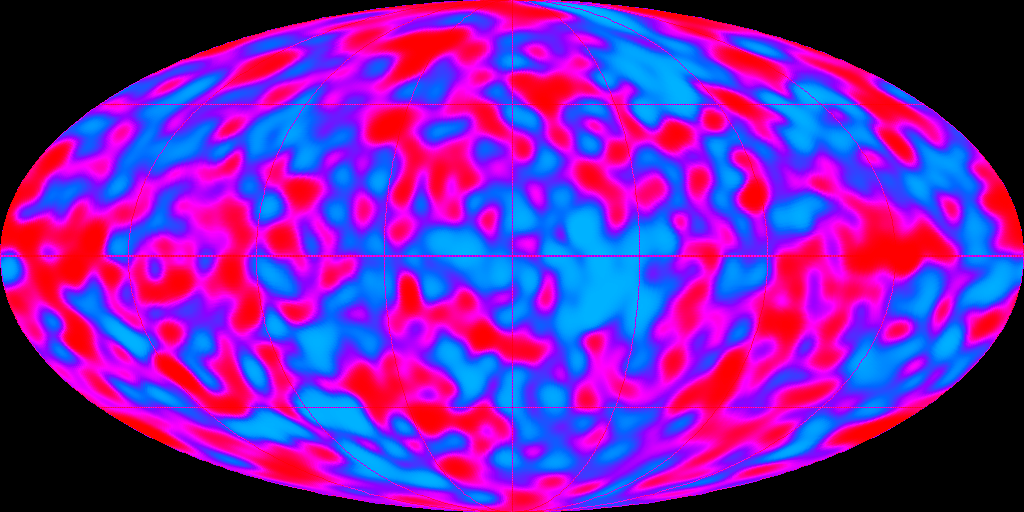
Red is only 100 μK (10e-6) greater than average. Blue is only 100 μK lesser than average.
Image Credit:
The COBE datasets were developed by the NASA Goddard Space Flight Center under the guidance of the COBE Science Working Group
- WMAP (Wilkinson Microwave Anisotropy Probe) launched by NASA in 2001

5-Year Data release (average temperature 2.725K, range between 2.7248K (blue) to 2.7252K (red)
Image Credit:
Subscribe to:
Posts (Atom)