Showing posts with label evolution. Show all posts

30 April 2015

The Density Parameter

In previous posts, I've discussed the density of the universe in terms of all the matter and energy the universe contains. I've also mentioned how the universe has a critical density, i.e. the matter and energy density required to make the universe flat (expanding forever while reaching a finite distance asymptotically.


Let's remember what we mean by open, closed, and flat universes.
  • An open universe is a universe that has a smaller density than the critical density. An open universe will expand forever and never reach a finite size.
  • A closed universe is a universe with a larger density than the critical density. A closed universe will reach a maximum size then gravity will take over and cause the universe to collapse.
  • A flat universe is a universe with a density equal to the critical density.


What we can measure is something called the density parameter, Ω. It is the ratio between the actual density of the universe and the critical density. If Ω is less than one, we live in an open universe. If it is greater than one, our universe is closed. What is the value of Ω?


We know right now that Ω is close to one. We know this from all the observations and measurements we make. The amazing thing is the majority of the mass and energy in the universe can only be inferred by the measurements. Only 4% of the mass and energy is found in stars, gas, and dust that can be directly observed. Dark matter takes up 22% of the mass and energy. And the dark energy is a whopping 74% of the overall density of the universe.


We know that Ω is close to one because of the measurements we make. We also know that the density has to be close to the critical density because if it wasn't, we wouldn't be here.


If Ω was 0.95, the expansion would have been too much for gravity to counteract, gas clouds would not have collapsed, stars and galaxies wouldn't have formed, planets would not have condensed out of the stellar clouds, and life would never have a chance to even exist.


If Ω was 1.05, gravity would have overwhelmed expansion before it even had a chance to start. Without enough time for gas clouds to collapse, again, no stars, galaxies, planet, and yes, life could have formed.


We still don't know if we are in an open, a closed, or a flat universe. Right now, all evidence points to an open universe (with Ω slightly less than 1), but that is what is awesome about science. The search for knowledge means we could learn new things and change our perception of the universe.




15 February 2015

This Is the Way The Universe Ends

I'm sorry, I lied.  We don't really know how the universe will end. Will the universe end with a whimper, will it end with a bang, or will it end with a crunch?
Here's what we know. The universe is essentially flat. How close to flat is the question. let's say the flatness is one. If we make the flatness just a little bit less than 1, we will call that an open universe which means that eventually gravity will lose out to the expansion of the universe. However, if we may be fun is to be loved a greater than 1, we call that close universe and eventually gravity will overtake the expansion of  the universe, and we will start to shrink again.
How do we determine if the universe is open, closed, or flat? We look at something called the critical density of the universe. Now the critical density is basically all the energy and mass required to make the universe flat. If we compare the actual density of the universe to the critical density that's where we get the value of one. If the actual density is less than the critical density, the ratio between the actual density to the critical density will be less than one and we will have an open universe again this means that gravity will lose out to the expansion of the universe. If the actual density is greater than the critical density, gravity will eventually win out.
Next time we'll talk about the curvature of the universe and how that relates to being open, closed, or flat. Each of these three types of universes will result in a different type of ending of the universe, or for two of them, there actually would be no ending. but don't worry, earth and the solar system will be long gone by time universe really does end.

11 February 2015

Cosmic Microwave Background Radiation


Last time, we mentioned something called the Cosmic Microwave Background Radiation (CMBR), which is a remnant of the Big Bang. The presence of the CMBR gave rise to questions about the evolution of the Universe. There is no reason the CMBR should be as uniform as it appears to be. So what is the CMBR?


First, let's give a little background about what the CMBR really is. THE CMBR was actually discovered by accident even though it was predicted. In 1948, Ralph Alpher and Robert Herman predicted a background radiation in the Universe to be about 5 K based on the Hubble constant (revised up to 28 K just two years later). But despite attempts to observed the cosmic background radiation, it was elusive. It wasn't until 1964, when Arno Penzias and Robert Wilson encountered unexplained radio noise with an antenna for Bell Labs intended for use in radio astronomy. At first, they thought that the noise was due to pigeon droppings in the dish of the radio antennae, but after cleaning the dish and shooting the pigeons (which each claim the other ordered), the noise still existed, even finding that the noise level and signal were the same no matter where the antenna was pointed. Contacting Robert Dicke (whose design the antenna was modeled after), they and Dicke published a paper with Penzias and Wilson describing their findings and Dicke suggesting that the noise was actually the CMBR that had been predicted before. The presence of the CMBR was able to confirm the idea that the Big Bang may have really occurred.


The CMBR itself is the remnant of the Big Bang and permeates all of the Universe. It is from the leftover energy from recombination and has been carried along with space as space has expanded since the beginning of the Universe. The CMBR can be thought to be embedded in spacetime, and as space has expanded, it causes the wavelength of the CMBR to increase over time as well.
The CMBR is found to have a temperature of only 2.73K and is fairly uniform in all directions. There have been two NASA spacecraft studies (so far) to measure the CMBR.
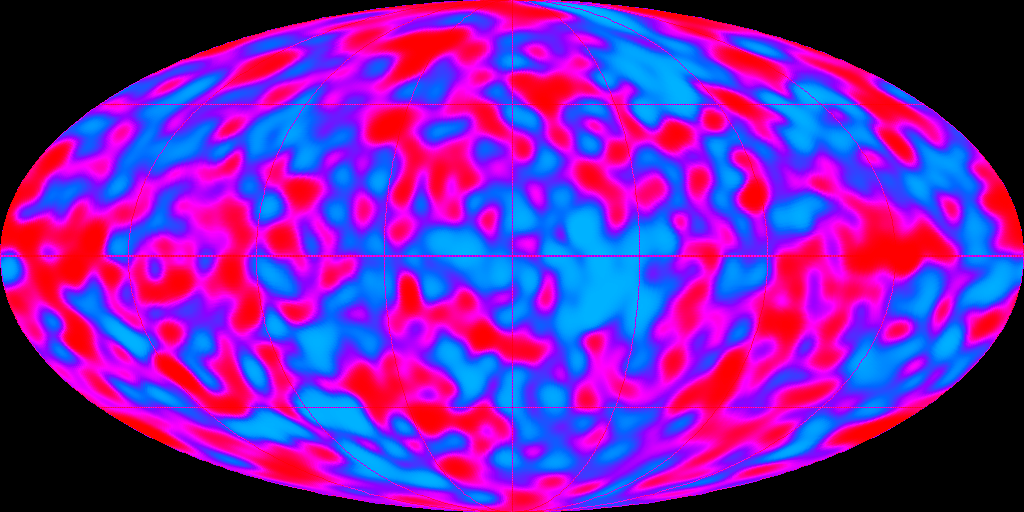
  • COBE (COsmic Background Explorer) launched by NASA in 1989 gave this famous image of the CMBR
File:COBE cmb fluctuations.png
Red is only 100 μK (10e-6) greater than average. Blue is only 100 μK lesser than average.
Image Credit:
The COBE datasets were developed by the NASA Goddard Space Flight Center under the guidance of the COBE Science Working Group
  • WMAP (Wilkinson Microwave Anisotropy Probe) launched by NASA in 2001
File:WMAP 2008.png
5-Year Data release (average temperature 2.725K, range between 2.7248K (blue) to 2.7252K (red)
Image Credit: